Our Methodology
Commercial Triage Before Institutional Due Diligence
Every physical fuel transaction requires decisions about whether institutional resources should be committed.
Before capital is deployed, organizations routinely commit legal, compliance, banking, management, and underwriting resources to evaluate the proposed transaction.
These activities are essential. However, they generally begin after a decision has been made to pursue the transaction.
PCS was developed to answer an earlier question.
Does the proposed transaction warrant the commitment of institutional resources?
PCS complements institutional due diligence by providing an independent commercial underwriting assessment before substantial institutional resources are committed.
Triage Before Due Diligence
Our objective is to help organizations identify procedural deficiencies and commercial inconsistencies early, allowing institutional due diligence to be applied where it is most valuable.
The PCS Approach
Every physical fuel transaction should reconcile into a coherent commercial, operational, and capital framework.
Among the questions PCS considers are:
- Does the reported origin reconcile with the product’s current location?
- Is the proposed volume consistent with normal refinery production and transportation practices?
- Do the transaction economics support a commercially viable trade?
- Is there a coherent relationship between title, custody, and commercial control?
- Do the proposed execution procedures describe a logical path from commercial agreement through physical delivery and payment?
When these elements reconcile, the transaction presents a commercially coherent framework suitable for institutional due diligence.
PCS does not recommend whether a transaction should proceed. It provides an independent underwriting assessment to support the client’s decision regarding further institutional review.
Underwriting Eligibility Assessment (UEA)
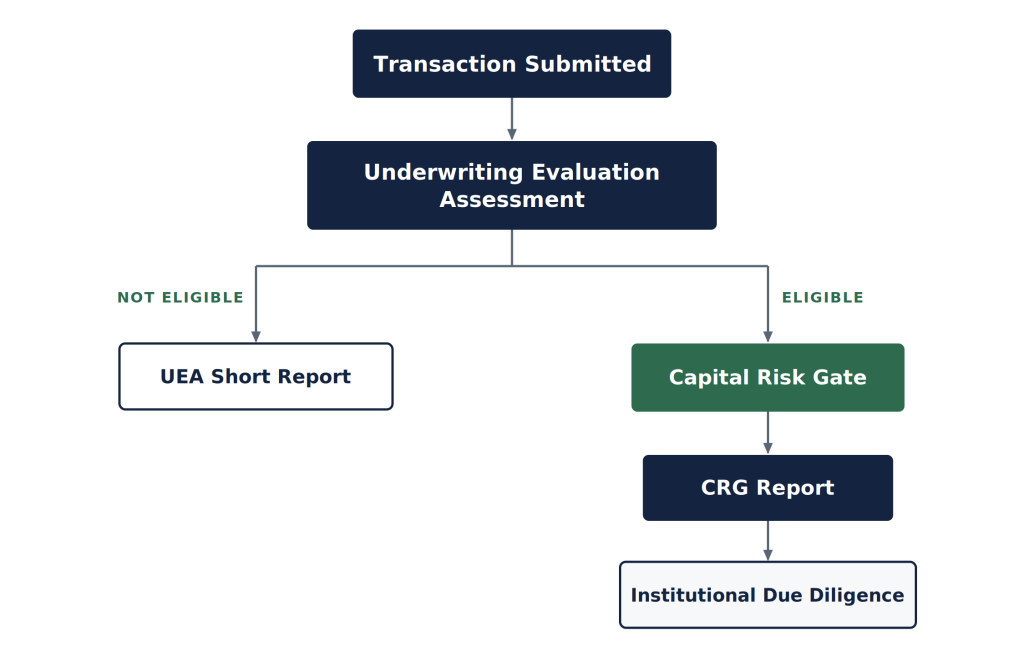
Every transaction submitted to PCS first undergoes an Underwriting Eligibility Assessment.
The UEA does not determine whether a transaction should proceed to full underwriting.
It is a procedural screening process designed to determine whether the submission contains sufficient information and procedural coherence to support a meaningful Capital Risk Gate evaluation.
Transactions may be determined to be ineligible for a full evaluation because of incomplete submissions, unresolved procedural inconsistencies, or structural deficiencies that prevent a reliable commercial assessment.
When this occurs, PCS issues a concise Underwriting Eligibility Assessment Report describing the principal procedural observations supporting that determination.
For complete submissions, the UEA is designed to provide an eligibility determination rapidly—typically within one hour of receiving a complete submission—allowing organizations to make informed continuation decisions while opportunities remain actionable.
Every document presented in support of a proposed transaction should correspond to a specific transaction event. The UEA evaluates whether each document can be reconciled to the transaction event it is intended to represent and whether those events collectively describe a coherent execution sequence capable of supporting further underwriting.
Capital Risk Gate (CRG)
Transactions determined to be eligible for evaluation proceed to the Capital Risk Gate.
CRG evaluates the commercial realities of the proposed transaction through six core areas of commercial analysis.
These areas were selected because each can be evaluated using observable commercial information, defensible rule-based analysis, and established market practice.
The six areas of commercial analysis are:
- Volume – Whether the proposed quantity reconciles with refinery production, transportation, and established market practice.
- Price – Whether the proposed pricing structure supports commercially viable transaction economics.
- Origin – Whether the reported origin, current location, and chain of custody reconcile with normal commercial practice. This analysis also identifies sanctions considerations associated with the reported origin, transit route, or destination that may require further legal or compliance review.
- Title & Commercial Control – Whether ownership, physical custody, and commercial authority reconcile with the proposed transaction structure.
- Logistics – Whether the proposed transportation, storage, delivery path, and logistical arrangements reconcile with normal commercial practice and support the proposed execution strategy.
- Execution Reality – Whether the proposed execution procedures describe a commercially coherent sequence from commercial agreement through delivery, document presentation, and payment.
In addition to these commercial analyses, the report includes Capital Considerations, discussing the capital requirements and institutional resource implications associated with the proposed transaction. These observations are intended to inform institutional decision-makers and are not themselves a commercial evaluation.
For complete submissions, the Capital Risk Gate is designed to deliver a structured report within approximately one hour of receiving a complete submission. In the time-sensitive environment of physical fuel trading, early commercial observations allow institutions to make continuation decisions while opportunities remain actionable.
Independent Commercial Underwriting
PCS provides an independent commercial underwriting assessment.
PCS does not provide:
- A broker or intermediary
- A trader or supplier
- A financing source
- Legal counsel
- A compliance or sanctions advisor
When a transaction proceeds to a full Capital Risk Gate evaluation, the report is intended to support the client’s decision regarding further institutional due diligence.
When a transaction is determined to be ineligible during the Underwriting Evaluation Assessment, PCS recommends that the identified procedural deficiencies be resolved before additional institutional resources are committed.
Our Process
Step 1
Submit transaction documents to PCS.
Step 2
PCS performs an Underwriting Evaluation Assessment. If the submission is not eligible for evaluation, PCS issues a concise UEA Report identifying the principal procedural observations. If the submission is eligible, the transaction proceeds to a full Capital Risk Gate evaluation.
Step 3
PCS completes the Capital Risk Gate assessment.
Step 4
PCS delivers a structured report documenting its commercial analyses, observations, and Capital Considerations.
Step 5
The client determines whether to proceed with legal review, compliance, financing, and institutional due diligence.
Our Objective
Institutional due diligence is one of the most valuable risk management tools available.
Its value increases when it is applied to transactions that warrant further investigation.
PCS was developed to help organizations identify procedural deficiencies and commercial inconsistencies before substantial institutional resources are committed, enabling institutions to allocate their legal, compliance, banking, management, and capital resources more effectively.
Methodology Testing
The PCS underwriting methodology has been tested against more than 400 physical petroleum transaction scenarios. Testing includes both scenarios representative of problematic transactions encountered in physical petroleum trading and a separate controlled test population deliberately distributed across pass, review, and fail outcomes.
The controlled population is designed to test whether the methodology consistently distinguishes between transactions that should not proceed, transactions requiring further review, and transactions whose characteristics support continued evaluation. This provides a broader test of the methodology than evaluating predominantly problematic transactions alone.